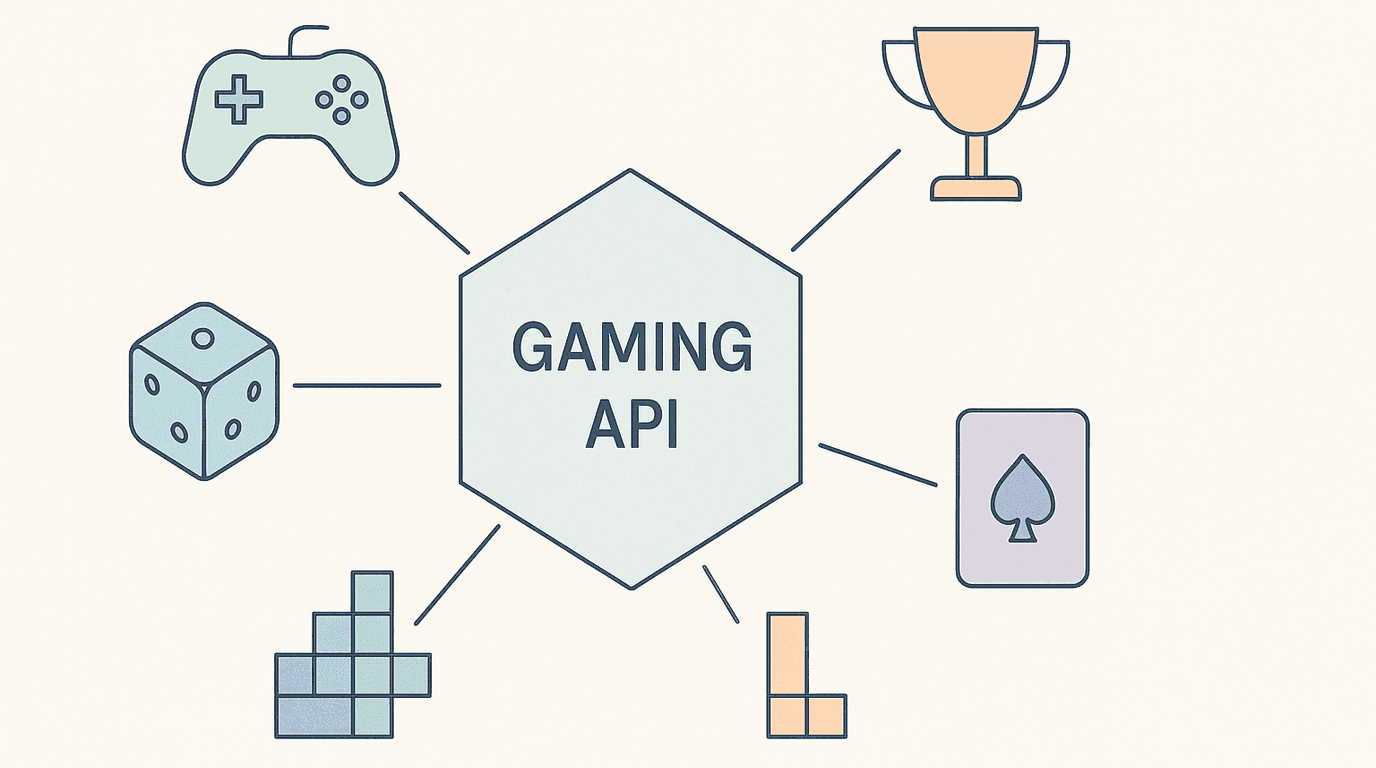
Gaming is one of the richest categories in free APIs, partly because the community around it has built and maintained a lot of it. You can get game catalogs, player statistics, card databases, giveaway listings and trivia questions without paying anything, and in many cases without even registering.
The difficulty is that "gaming API" covers at least four unrelated things. Knowing which kind you need narrows ten options down to one or two quickly.
Four kinds of gaming API
Catalogs answer "what games exist and what are they about" — titles, release dates, genres, platforms, cover art, ratings. RAWG and IGDB live here.
Player data answers "what has this specific person done" — owned games, achievements, match history, rank. Steam, Riot and Chess.com live here, and they all involve some form of identity.
Game-specific data answers "what is inside this one game" — Pokémon species and moves, Magic card rules text. PokéAPI and Scryfall live here, and they are far deeper than a general catalog could ever be.
Content sources provide raw material for something you are building rather than data about games — trivia questions, giveaway listings. Open Trivia DB and GamerPower live here.
Quick comparison
| API | Category | Auth | Rate limit shape |
|---|---|---|---|
| RAWG | Catalog | Free API key | Monthly quota |
| IGDB | Catalog | Twitch OAuth | Requests per second |
| Steam Web API | Player data | Free key | Daily quota |
| Riot Games | Player data | Dev key, expires | Strict short-window limits |
| Chess.com | Player data | None | Fair use, serial requests |
| PokéAPI | Game-specific | None | Fair use, caching expected |
| Scryfall | Game-specific | None | Delay between requests requested |
| Open Trivia DB | Content | None | One request per few seconds |
| FreeToGame | Content | None | Fair use |
| GamerPower | Content | None | Fair use |
RAWG — the practical default for game catalogs
RAWG hosts one of the largest freely accessible video game databases, spanning a very wide range of platforms including older and more obscure ones.
It is the easiest of the two big catalogs to start with. You register, receive an API key, and pass it as a query parameter. There is no OAuth flow, no token refresh, no separate developer platform. For a game search box or a "browse by genre" screen, you can have something working in minutes.
The data is well suited to discovery interfaces: screenshots, ratings, genres, tags, platforms and release dates all come back in a shape you can render directly. Search is forgiving of imprecise queries, which matters when users type game titles from memory.
The free tier operates on a monthly request quota. That number sounds large until you build a page that fires several requests per view — a list plus detail lookups plus screenshots. Cache aggressively and fetch detail only when a user actually opens an item.
Read the terms before shipping commercially. RAWG's free usage carries attribution requirements, and commercial use above certain thresholds is expected to go through a separate arrangement.
IGDB — deeper structure, higher setup cost
IGDB is owned by Twitch, and that shapes everything about using it. Authentication goes through a Twitch developer account and an OAuth client-credentials flow: you register an application, exchange your client credentials for an access token, and refresh it when it expires.
Queries are also unusual. Instead of REST-style query parameters, you POST a query written in a compact purpose-built syntax, specifying exactly which fields you want and how to filter and sort them. It feels awkward for about an hour and then becomes genuinely pleasant — it is closer to writing a database query than assembling a URL, and it lets you traverse relationships in a single request.
That relationship depth is IGDB's real advantage. Companies, franchises, game engines, release dates per region and platform, DLC relationships and game modes are all modelled as first-class linked entities. If you are building something analytical — comparing franchises, tracking a studio's output over time — this structure saves you from stitching data together yourself.
Rate limiting is enforced on a per-second basis, so the failure mode is bursts rather than volume. Queue your requests.
Choose IGDB when the relationships between games matter to your product. Choose RAWG when you mostly need to look games up and show them.
Steam Web API — player data, with caveats
The Steam Web API gives you access to player profiles, owned games, playtime, achievements and app details. A free key is available to any Steam account holder.
Its strength is that playtime and achievement data is not available anywhere else. An application that shows a user their own gaming statistics, or builds recommendations from their library, has to come here.
There are two caveats worth knowing before you commit.
First, privacy settings gate almost everything. A user with a private profile returns nothing, and this is by far the most common support question such apps receive. Design for it: detect the empty response and explain that the profile is private and how to change it, rather than showing a broken empty state.
Second, not everything developers use is formally documented. Store and pricing endpoints in particular are widely used but sit outside the documented developer surface, which means they can change without notice or deprecation. Keep anything built on them isolated behind a small module, validate the responses, and be prepared for it to break.
Riot Games — the most restricted of the set
The Riot Games API covers League of Legends, Valorant and other Riot titles: match history, ranked standing, champion mastery.
It is included here with a warning. Development keys expire on a short cycle and must be regenerated, and the rate limits are strict enough that you feel them immediately. Running a real application requires applying for a production key, which involves describing your project and having it reviewed.
This is not an API you drop into a weekend project and forget about. If Riot titles are central to what you are building, the process is worth it and the data is excellent. If you just want some game data to display, look elsewhere.
PokéAPI — the one everyone learns on
PokéAPI is probably the most widely used API in programming tutorials, and for good reason: no key, no registration, clean REST design, and a dataset almost everyone already understands.
The data goes far deeper than most people expect. Species, forms, types, abilities, moves with their power and accuracy, evolution chains, encounter locations, held items — the relationships are modelled thoroughly enough to build genuine game tools, not just demo apps.
The design detail worth knowing is that resources link to each other by URL rather than embedding. Fetching a Pokémon gives you references to its abilities and moves; getting their details means following those links. A single "show me this Pokémon" screen can easily become twenty requests if you follow every reference naively.
The maintainers ask that you cache locally rather than hammering the service, and they also publish the full dataset for local use. If your application needs the whole dataset, take the data rather than crawling the API for it — it is faster for you and kinder to a free community service.
Scryfall — how a niche API should be built
Scryfall serves Magic: The Gathering card data, and it is worth studying even if you never touch the game. It is one of the best-designed free APIs available.
No key is required. The search syntax is genuinely powerful — the same expressive query language the website exposes to players is available through the API. Card images come in multiple sizes and formats. Rulings, printings across sets, and prices from multiple sources are all included.
The maintainers ask clients to insert a short delay between requests rather than firing in parallel, and to identify themselves with a user agent. They also publish bulk data files, and their documentation is explicit that if you need many cards you should download the bulk file rather than iterate the API. Following that guidance is both faster and the reason the service can stay free.
Card artwork carries separate intellectual property considerations from the card data. Displaying images in a deck builder is normal practice; redistributing them as your own asset library is not.
Open Trivia DB, FreeToGame and GamerPower
Three smaller keyless services cover specific niches well.
Open Trivia DB provides multiple-choice trivia questions by category and difficulty. It is the fastest way to build a quiz application. Its session token feature is easy to overlook and worth using — it prevents the same question repeating within a session, which is the single most noticeable quality problem in quiz apps. Note the enforced gap between requests: fetch a batch of questions once rather than one per round.
FreeToGame lists free-to-play games with platform, genre and description. Useful for discovery sites and for anyone who wants a games list without dealing with a large catalog's complexity.
GamerPower tracks game giveaways and loot offers across platforms. It powers a specific and popular kind of site, and its data is time-sensitive by nature — cache briefly, and always show expiry.
Chess.com's published data endpoints round out the set with player profiles, rating history and monthly game archives, no key required. It is read-only and asks that you make requests serially rather than in parallel.
Rate limits: the mistake almost everyone makes
Nearly every rate-limit problem developers hit with these APIs comes from the same misunderstanding.
You read "20,000 requests per month", divide by thirty days, conclude you have plenty of headroom, and write a loop that fires two hundred requests in parallel to fill a page. The requests start failing immediately, and the daily numbers say you are nowhere near the limit.
The reason is that most of these services enforce a short-window limit — per second, or per few seconds — separately from any monthly quota. Two hundred simultaneous requests trip the short window instantly no matter how much monthly quota remains.
The fix is structural, not incremental. Route outbound calls through a single queue with a concurrency limit of one or two. Add exponential backoff on 429 responses rather than retrying at a fixed interval, which makes congestion worse. Read the rate-limit headers in responses where they are provided and slow down before you are rejected rather than after.
And cache. Game metadata barely changes — a game's release date and genre are the same tomorrow as today. Player statistics and giveaway listings change, but even those tolerate minutes of staleness. Most applications built on these APIs could reduce their request volume by an order of magnitude with a cache layer and lose nothing a user would notice.
Licensing and commercial use
Free access and free reuse are different things, and this category makes the distinction sharper than most.
Three separate questions apply to any of these services. Does the provider permit commercial use of the API on your tier? Does it require attribution, and in what form? And separately from both — who owns the underlying content?
That third question is the one people skip. Game titles, cover art, card images and character data are intellectual property belonging to publishers, not to the API that indexes them. An API's terms can grant you access to its service; they cannot grant you rights the provider does not hold. A hobby project displaying cover art is a different risk profile from a commercial product built on redistributing that art.
For anything you intend to monetise, read each provider's terms directly, and give a thought to the content owner as well.
Rate limits, quotas and access terms in this article reflect official documentation at the time of publication. These services update their limits periodically, so verify current values before you rely on them in production.
Related API Deposu entries
- RAWG Video Games Database
- IGDB
- Steam Web API
- Riot Games API
- PokéAPI
- Scryfall
- Open Trivia DB
- FreeToGame
- GamerPower
- Chess.com Published Data
Sources
Frequently Asked Questions
›Which game API needs no key at all?
PokéAPI, Scryfall, Open Trivia DB, FreeToGame, GamerPower and the Chess.com published-data endpoints are all usable without registration. RAWG, IGDB, Steam and Riot all require credentials.
›Is there a free alternative to IGDB?
RAWG is the closest equivalent for general video game metadata and has a simpler REST interface with a straightforward API key. IGDB goes deeper on structured relationships but requires a Twitch developer account and an OAuth flow.
›Does Steam have a public API?
Yes. The Steam Web API exposes player, achievement and app data with a free key. Note that a portion of what developers commonly use — particularly store and pricing endpoints — is not part of the formally documented surface and can change without notice.
›Can I use these APIs in a commercial product?
It varies and you must check each one. Several allow commercial use with attribution, some restrict the free tier to non-commercial projects, and game content itself may carry separate intellectual property restrictions regardless of how you obtained the data.
›Why does my request get rejected even though I am under the daily limit?
Most of these services enforce a short-window limit — requests per second or per few seconds — in addition to any daily quota. A burst of parallel requests trips the short-window limit long before you approach the daily one. Queue requests serially and add backoff on 429 responses.