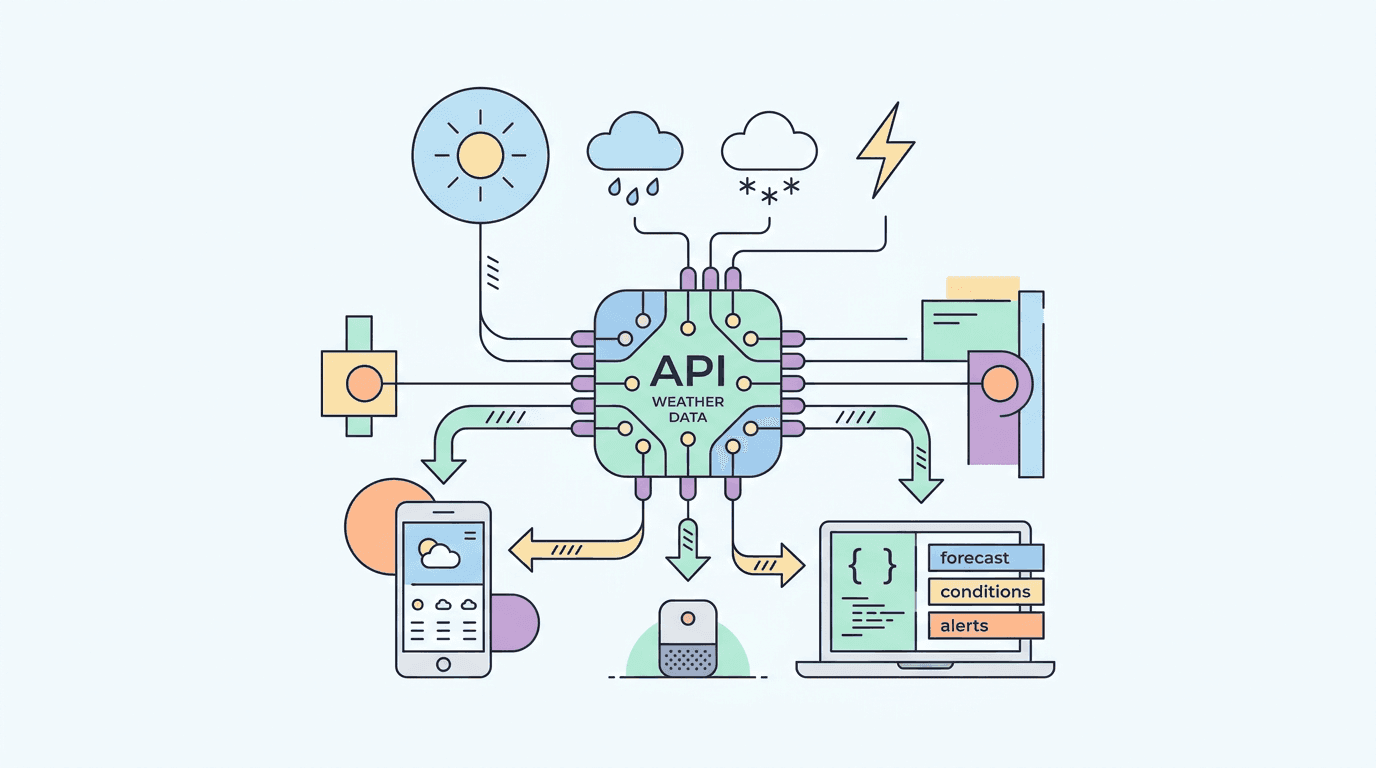
Most weather API listicles end with the same conclusion: sign up for a freemium plan, hand over a credit card, and pray you stay under the rate limit. This list takes a different angle. Every API below is genuinely free for development and small production workloads, and most do not require an API key at all.
Quick comparison
| API | Coverage | Auth | Sign-up needed |
|---|---|---|---|
| Open-Meteo | Global | None | No |
| MET Norway Weather API | Global | User-Agent header required | No |
| US National Weather Service | United States | None | No |
| MGM (Türkiye) | Türkiye | None (unofficial XML) | No |
What "free" actually means here
For a weather API to qualify for this list, it has to:
- Work without a paid plan or trial timer.
- Allow real production traffic, not just a 100-call sandbox.
- Either skip authentication entirely or use a lightweight identifier (like a User-Agent header) instead of an account.
Pricing pages move and free tiers get clipped. Always check the official docs linked in each section before you ship.
API options
Open-Meteo
Open-Meteo is the easiest place to start when you need a global weather API and you don't want to think about auth at all. It returns hourly and daily forecasts by latitude and longitude, plus current conditions like temperature, wind, and humidity, and it does so without requiring an API key.
The integration shape is familiar: a single GET request with latitude, longitude, and the variables you want. That keeps it well-suited for weather widgets, dashboards, and anywhere you would otherwise embed a third-party iframe.
Things to weigh before committing:
- The catalog flags integration complexity as medium — not because the request is hard, but because the response includes a lot of optional fields and you will need to pick the variables you actually want.
- Free use is generally allowed, but heavy commercial workloads should be checked against the current Open-Meteo terms.
- There is no SLA. For production-critical use, plan for retries and a fallback.
MET Norway Weather API
The MET Norway Weather API comes from the Norwegian Meteorological Institute and offers free, global, coordinate-based hourly and daily forecasts. It is the API behind a lot of the weather data you already see in open-source apps.
The one rule worth remembering: a descriptive User-Agent header is mandatory. Requests without one are rejected. Use something like MyApp/1.0 contact@example.com so the operators can reach you if there is an issue.
This API shines when:
- You want a stable, government-operated source.
- You need global coverage and are happy to send a contact-style User-Agent.
- You are building something where attribution back to the data source is acceptable.
US National Weather Service
US Weather (api.weather.gov) is the official, no-auth, read-only API from the U.S. National Weather Service. If you are building anything that focuses on the United States — alerts, forecasts, regional reports — this is the canonical source.
Why it matters:
- Backed by a government agency, so the data is the same data downstream commercial APIs are reselling.
- No API key, no rate-limit math against your plan tier.
- Great fit for weather-alert apps, hyperlocal dashboards, and any product targeting U.S. users.
The tradeoff: coverage is U.S.-only. For an international product you will pair this with one of the global options above.
MGM (Türkiye)
For Türkiye-focused apps, MGM is the data source you are looking for. It exposes city-level and regional forecasts based on data published by the Turkish State Meteorological Service.
Two important caveats:
- This is an unofficial XML feed scraped from the MGM website, not a documented public API. The structure can change without notice.
- For a production product targeting Turkish users, treat this as your default source for local data — but build your parser defensively and monitor for breakage.
If you are building a weather widget for a Turkish SaaS, a regional dashboard, or a localized news app, MGM gives you accurate domestic data that the global APIs cannot match for granularity.
Picking the right one
Match the API to the product, not the other way around:
- Global widget, no setup friction → Open-Meteo.
- Global app where you want a government-backed source → MET Norway.
- U.S.-only product, alerts and forecasts → US National Weather Service.
- Türkiye-focused product needing local accuracy → MGM, with a fallback to a global source.
A common production setup is to use one global source as the default and one regional source where you have a strong audience, then fall back to the other when the primary source fails or has gaps.
When not to use these APIs
These are excellent free options, but they are not the right fit when you need:
- A formal SLA or paid support. None of these come with one. If your product depends on weather data being correct within a defined uptime, you will need a commercial provider.
- Severe-weather alerting in regions outside their coverage. Pair them with regional government feeds.
- Historical climate analysis at scale. Some of these expose history endpoints, but heavy archival workloads are better served by datasets built for that purpose.
Related API Deposu entries
Sources
Frequently Asked Questions
›Which free weather API does not require any sign-up?
Open-Meteo and the US National Weather Service API both work without an account or API key. MET Norway also requires no account, but you must send a descriptive User-Agent header.
›What is the best weather API for a Türkiye-focused product?
MGM is the closest source to local Turkish weather data. Treat it as your default for domestic accuracy and pair it with a global source like Open-Meteo for fallback, since the MGM feed is unofficial and the structure can change.
›Are these APIs safe for production?
They are widely used in production, but none of them come with a contractual SLA. If your product depends on guaranteed uptime or formal support, plan for retries, fallback to a second source, and consider a commercial provider for the critical path.
›Do any of them require a credit card?
No. Every API in this list is free to use without entering payment details. Always re-check the official terms before shipping a commercial product, since free-tier conditions can change.