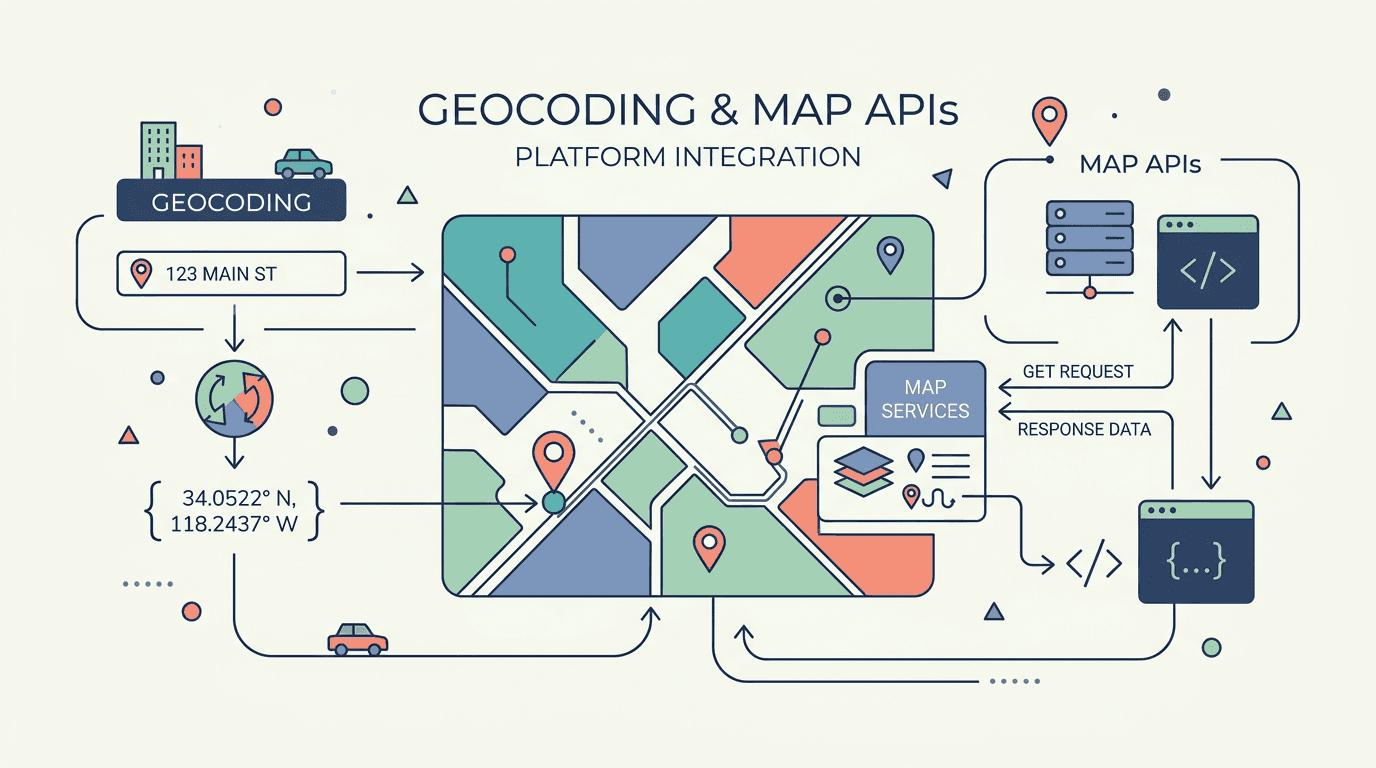
Geocoding APIs turn addresses into coordinates. Reverse geocoding does the opposite: coordinates become address-like place data. The best provider depends on your product, not just the endpoint name.
This draft compares four API Deposu catalog entries that can support address search, reverse geocoding, listing maps, delivery flows, and location enrichment. Review current pricing, usage policies, attribution, and rate limits before publishing or production use.
Quick comparison
| API | Best fit | Auth model in catalog | Strongest reason to choose it |
|---|---|---|---|
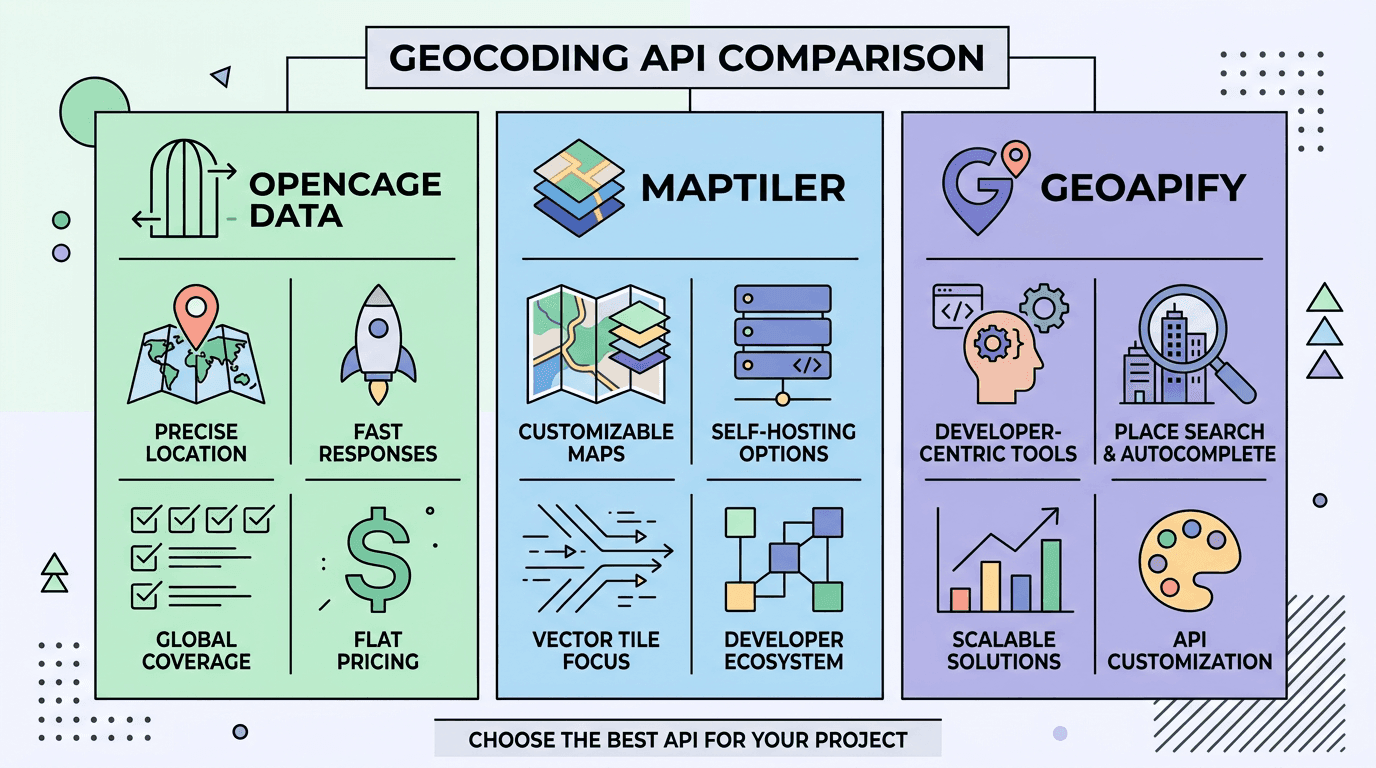
| OpenCage | General geocoding and reverse geocoding | API key | Straightforward geocoding service with global coverage focus |
| MapTiler | Products that also need maps and tiles | API key | Geocoding can sit beside the same provider's map stack |
| Geoapify | Location products that need geocoding plus POI lookup | API key | One provider can cover geocoding and places-style enrichment |
| Nominatim | OpenStreetMap-based lookup and low-volume public use | No key for public service | Useful for OSM-oriented tools, with strict public usage policy constraints |
OpenCage
OpenCage is a focused geocoding provider. It is a good option when you want a dedicated service for address search and reverse geocoding without adopting a full map platform.
Use OpenCage when:
- You need global forward and reverse geocoding.
- You want a simple API-key integration.
- You can review quota, attribution, and licensing requirements before launch.
For production products, treat geocoding as a backend operation. Normalize provider responses into your own address, latitude, longitude, and confidence fields instead of passing raw provider objects through the UI.
MapTiler
MapTiler is useful when geocoding is part of a broader map experience. If the product already needs map rendering, tiles, and location search, keeping those capabilities under one provider can simplify vendor management.
Use MapTiler when:
- The product needs geocoding and map display together.
- You want autocomplete and reverse geocoding around a map-first UI.
- You are already evaluating MapTiler for tiles or SDK usage.
The main review item is usage terms. Map and geocoding plans can have different constraints, so verify current limits and commercial-use requirements before publishing a recommendation.
Geoapify
Geoapify fits products that go beyond address conversion. It can support geocoding, reverse geocoding, and place or point-of-interest workflows under one provider.
Use Geoapify when:
- You need nearby places around a listing or user location.
- You want address normalization and location enrichment in one stack.
- You can build rate limiting and cache behavior around provider credit usage.
Geoapify is especially relevant for real estate, local search, logistics, and marketplace products where coordinates are only the first step.
Nominatim
Nominatim is the OpenStreetMap geocoding service. It is valuable for OSM-based tools, research workflows, and low-volume public lookups, but it should not be treated like an unrestricted commercial geocoding backend.
Use Nominatim when:
- You need OpenStreetMap-based search or reverse geocoding.
- Your usage fits the public service policy.
- You can send a proper user agent, cache responses, and keep request volume low.
For serious production traffic, evaluate self-hosting Nominatim or using a commercial provider that supports your volume and support requirements.
Product-based recommendation
- Real estate listing search: start with OpenCage, MapTiler, or Geoapify.
- Map-heavy user interface: evaluate MapTiler early.
- Nearby places and location enrichment: evaluate Geoapify.
- OSM research or low-volume lookup: Nominatim can work if usage policy requirements are followed.
- High-volume production geocoding: use a commercial plan or self-hosted architecture with explicit capacity planning.
Implementation checklist
- Keep provider keys on the server side when possible.
- Cache geocoding results for stable addresses.
- Store the original user query and normalized result separately.
- Track confidence, result type, and bounding box if the provider returns them.
- Add a manual review path for low-confidence or ambiguous addresses.
- Respect attribution and usage policy requirements in the UI.
- Avoid sending precise user locations to a provider unless your privacy policy covers it.
FAQ
Which geocoding API is best for a SaaS product?
Choose based on workflow. OpenCage is a clean general-purpose geocoding option, MapTiler is compelling for map-heavy products, Geoapify is strong when places data matters, and Nominatim is best for OSM-aligned low-volume use or self-hosted setups.
Can I use Nominatim for a production app?
Only if your use follows the public usage policy, or if you self-host or use a provider that supports your traffic. The public service should not be treated as an unlimited production backend.
Should I store geocoding results?
Usually yes, if the provider terms allow it and your privacy policy supports the data use. Caching stable address results reduces latency, cost, and provider load.
How does API Deposu help compare these?
API Deposu keeps catalog entries for each provider with docs links, auth notes, playground endpoints, and related implementation context so developers can compare integration shape before writing production code.
Related API Deposu entries
Sources
Frequently Asked Questions
›Which geocoding API is best for production apps?
OpenCage, MapTiler, and Geoapify are better production candidates than the public Nominatim service because they are commercial API products with key-based access. The right choice depends on whether you need only geocoding, a full map stack, or places-style enrichment.
›Can I use Nominatim for a commercial geocoding backend?
Do not treat the public Nominatim service as an unrestricted commercial backend. Review the OpenStreetMap Foundation usage policy, cache responses, use a proper user agent, and keep request volume low or run your own instance.
›Should geocoding happen in the frontend or backend?
For production apps, geocoding is usually safer on the backend so you can protect API keys, cache responses, normalize provider fields, and enforce rate limits.