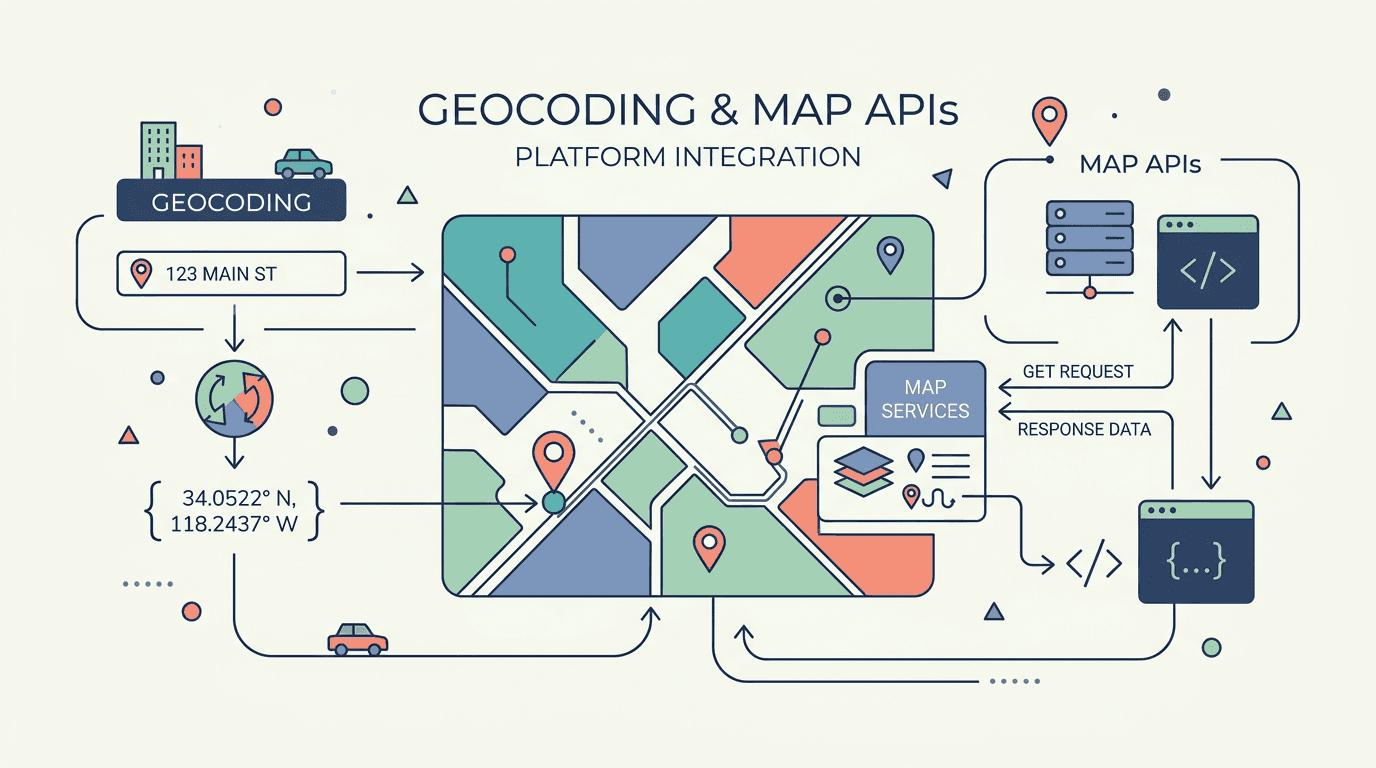
Google's Geocoding API is the default option developers reach for, but the pricing model and terms restrictions on caching push many production apps toward alternatives. This guide covers six replacements, from fully free open-source options to commercial APIs with friendlier terms.
Alternatives at a glance
| Alternative | Best for | Auth | Free tier signal |
|---|---|---|---|
| OSM Nominatim | Open-source, self-hostable | None (public has rate limit) | Free |
| Mapbox | Full geo platform (geocoding + maps + routing) | API key | Free |
| OpenCage | Simple geocoding with caching-friendly terms | API key | Trial |
| MapTiler Cloud | Geocoding + map tiles in one provider | API key | Limited |
| Geoapify | Geocoding + Places (POI) in one provider | API key | Limited |
| LocationIQ | Lightweight geocoding and autocomplete | API key | Limited |
Why look for an alternative?
The practical reasons developers move off Google Geocoding:
- Pricing. Google charges per request once you exceed the free tier. For products with high address-volume (real estate, logistics, marketplaces), this scales poorly.
- Caching restrictions. Google's terms historically restrict how long you can store geocoded coordinates. Some alternatives explicitly allow caching, which lowers your effective cost per request.
- Vendor concentration. Adding one more Google dependency to a stack already built on Google services increases lock-in.
- Map-stack consistency. If you are not using Google Maps for the visual map, mixing in Google for geocoding makes attribution and licensing more complex.
The right alternative depends on which of these reasons matter most to your product.
How to choose
Score the alternatives against your actual product needs:
- Data coverage — global vs. regional accuracy, address granularity, POI coverage.
- Documentation quality — both for the geocoding endpoint and for adjacent features (autocomplete, places, reverse geocoding).
- Auth complexity — keyless (Nominatim) vs. simple key (most others).
- Pricing and free-tier clarity — explicit per-month numbers vs. vague "limited" tiers.
- Caching and storage terms — critical for cost optimization.
- Production suitability — public Nominatim is not for production; the others are.
Alternative options
OSM Nominatim
OSM Nominatim is the canonical free geocoding service built on OpenStreetMap data. It is keyless, fully open-source, and self-hostable.
Use it when:
- You can self-host or are happy with the strict 1-request-per-second rate limit on the public instance.
- Your product's coverage matches OSM's data quality (excellent in some regions, weaker in others).
- You want the most permissive licensing — OSM data is open with attribution.
For production at any meaningful scale, plan to self-host or use a commercial provider built on OSM data (LocationIQ, Geoapify).
Mapbox API
Mapbox API is the broadest geo platform on this list — geocoding plus routing, isochrones, map tiles, and traffic data all from one provider.
Use it when:
- You want a single vendor for geocoding and the visual map.
- You need adjacent features like routing, navigation, or isochrones.
- You can integrate the Mapbox SDK alongside the API.
The free tier is generous for typical app workloads, and the pricing scales predictably from there.
OpenCage
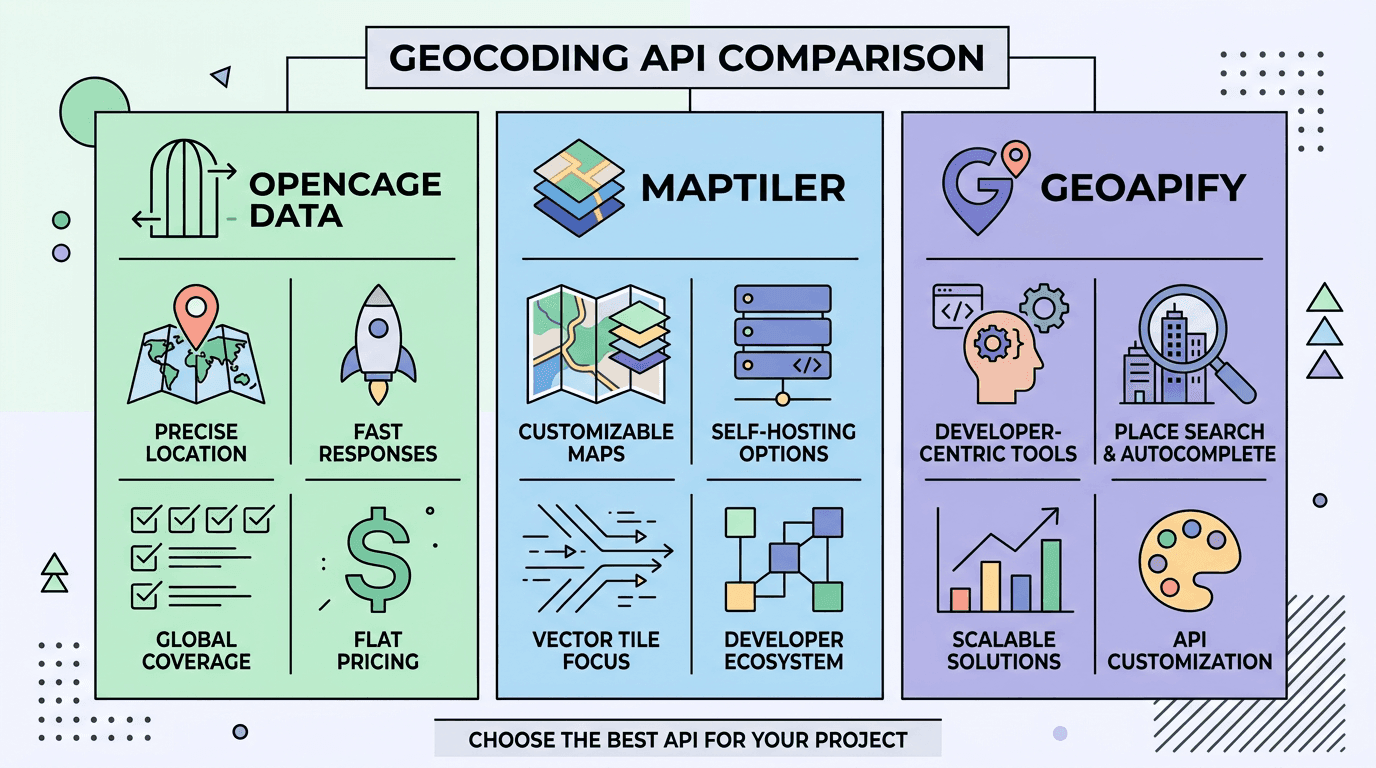
OpenCage is a simple, focused geocoding API with explicit terms allowing result caching — which is the differentiator from Google.
Use it when:
- You only need geocoding, not a full map platform.
- You want to cache results long-term to lower cost per request.
- You value clear, founder-led documentation.
The trial-style free tier is small but sufficient for development; production usage moves to a paid plan.
MapTiler Cloud
MapTiler Cloud bundles geocoding with map tiles, which makes it a strong choice when you want a single provider for both the address lookup and the map render.
Use it when:
- You are building a real-estate, listings, or logistics product where the map is part of the UI.
- You want one API key for both geocoding and tiles.
- You can work within the limited free tier while prototyping.
Geoapify
Geoapify bundles geocoding with a Places (POI) API. The POI side is the differentiator — looking up nearby schools, hospitals, restaurants, etc., from the same key.
Use it when:
- Your product needs POI search alongside geocoding (real-estate listings, neighborhood analysis).
- You want a single provider for both location lookup and surrounding context.
LocationIQ
LocationIQ is a lightweight, OSM-backed geocoding and autocomplete API, positioned as a developer-friendly alternative with a clean free tier.
Use it when:
- You only need geocoding, reverse geocoding, and autocomplete.
- You want OSM-quality data without self-hosting Nominatim.
- You value a simple, low-overhead integration.
Picking the right one
Match the alternative to the actual reason you are leaving Google:
- Cost-sensitive, high-volume → OpenCage (cache-friendly) or self-hosted Nominatim.
- Want a full geo platform → Mapbox.
- Map + geocoding from one vendor → MapTiler.
- Geocoding + POI → Geoapify.
- Pure geocoding, lean integration → LocationIQ.
- Pure open-source, willing to self-host → OSM Nominatim.
A common production setup uses one paid API for the primary path (Mapbox, OpenCage, or Geoapify) and self-hosted Nominatim as a fallback or for batch enrichment workloads where rate limits are easier to manage.
Related API Deposu entries
Sources
Frequently Asked Questions
›Why look for an alternative to Google Geocoding?
The most common reasons are pricing (Google charges per request after a small free tier), terms restrictions on caching and storing results, and dependency concerns. The alternatives in this list have more permissive caching terms and clearer pricing.
›Is OSM Nominatim a real production option?
Yes, but only with caveats. The public Nominatim server is rate-limited to 1 request per second and is not intended for heavy commercial use. For production, you should self-host Nominatim or use a commercial provider built on OSM data like LocationIQ or Geoapify.
›Which alternative is the closest match to Google's API shape?
Mapbox is the closest in terms of feature breadth (geocoding plus routing, isochrones, and tiles in one platform). OpenCage and LocationIQ are simpler if you only need geocoding.
›Can I cache or store geocoded results from these APIs?
Caching policies vary. OpenCage explicitly allows caching, OSM Nominatim allows it with attribution, and Mapbox and Geoapify each have their own rules. Always read the current terms before caching geocoded coordinates long-term.